Thursday, January 22, 2009

Themed Collections
Butterflies, part 1

Many collectors of Vintage Costume Jewellery prefer to stick to one theme.


It may be to collect brooches, necklaces, bracelets or earrings. Perhaps parures or demi-parures (matching sets or half sets). Some collect any item with the same theme. It could be cats, insects (see the butterflies above).


The butterflies pictured are part of my collection and range from the early part of the 20th century to fairly modern. Some can be worn as either a brooch or a pendant, having both a pin and a bale for use with a chain.


This butterfly has mesh wings and is gold plated. It belongs to a group called 'en tremblant'. The upper wings are attached with small spring-like devices which let them tremble as if flapping as the wearer moves.


These 3 small brooches measure no more than 2 cm each. From the left - base metal and rhinestones (1910-1930), centre - silver filigree (?Edwardian) right - carved mother of pearl with 6 brilliant stones (?1930's)

Monday, January 19, 2009

Do not hide your sparkles away in a drawer, brooches bring a sparkle to any outfit.


Do not keep your sparkling brooches just for evening wear.
When the sun catches and reflects on a rhinestone the brilliance can bring forth smiles.
Most offices and shops now have bright artificial light and these can bring out the colours in a rhinestone or glass brooch especially those with AB (aurora borealis) stones.
When the weather is dull and you are wrapped up in your winter coat, brighten the outfit with a large and colourful brooch and pin. Don’t hide them away for that occasional night out.


This oval brooch is from Slovakia and dates from between 1910 and 1930. I enjoy wearing this on a dark coat, and it never fails to bring forth compliments.
If you are wearing a shawl or scarf around your shoulders attach it with a bar of golden metal or a rhinestone brooch of Czechoslovakian origin.


This brooch
which looks fantastic worn on a scarf or shawl is one of my favourites. The
stones are not brilliant cut but cabochon.


AB stones are those that have been treated with
thin coats of metal to give it the colorful reflective quality. This process allows light to reflect many different colours. This process only came onto the market in the mid 50’s and one of the first fashion houses to use it was Christian Dior in conjunction with the Swarovski company who were instrumental in its conception.

So when you are thinking of buying a piece of jewellery with AB stones any claim that it Dates from before the mid fifties are false. The brooch pictured probably dates from the 1960's.

Saturday, January 10, 2009

Bracelet of 'Operculum' stones set in silver .

This is an interesting an somewhat unusual bracelet. The seven "stones" are not stones at all but are Operculum (latin for 'little lid').
They are in fact the 'lid' of certain gastropods and are more commonly known as Cats eye or Shiva's eye.
The ones pictured here are from the Turban Snail (Turbo petholatus). The underside is completely flat whilst the top is domed and with a dark green centre fading through cream to brown.
These operculum are set into silver to form this bracelet. These were first made popular in Victorian time.

Wednesday, January 7, 2009

Caring for your Vintage Costume Jewellery

Well the Christmas/New year season is over and here in France the cold weather has arrived with a bang. Temperatures as low as minus 9 celsius. So it is a good time to stay in the warm and look after and organise ones collection of vintage bling.
I shall be starting this afternoon by inspecting each piece for any loose stones and dusting each piece with an eyeshadow brush . I find these brushes are soft and ideal for getting into small crannies.
Vintage jewellery, or in fact any jewellery should be kept, where possible, individually. Wrapped in tissue or soft fabric or kept in it's original box.
Rhinestones, diamonte, chrystal, strass, whatever name you put to the stones, scratch and mark easily. So contact with each other especially the pins on the back should be avoided.
Make sure the place that you keep your treasured pieces is not damp, as this can cause damage to the metal content of your jewellery.
I have come across pieces in sale rooms that were obviously at one time beautiful ruined by water damage with either rusting pins or damage to the foil backing of the stones. This is such a pity when you can imagine how lovely they once were.
It is also a good time to take stock of your jewellery. Is your insurance up to date? Have you increased the value of your jewellery since the last premium? Do you have photographs of the pieces should they be stolen or lost? Also are there any pieces you no longer want in your collection? Would they be best taken to a jeweller to sell? Would they do well at an online on-line auction house such as ebay

Monday, December 15, 2008

Vintage Costume Jewellery from Czechoslovakia,


This morning my latest additions arrived and I thought I would share with you all this wonderful brooch.
This brooch is typical of the brooches to come out of Czechoslovakia in the 20's and 30's.
It has a diameter of 6 cms and is set in a golden filigree metal.
There is a central rose pink rhinestone (1cm diameter) and 36 further small rose pink stones.
It has a simple pin and c closure.
The photo does not show the the brilliance and sparkle to it's true level.
Other arrivals include an addition to my butterfly flock and more button covers(another collection of mine) but more of them later.

Sunday, December 14, 2008

Assorted Vide Grenier (Car Boot) Finds in France


I spent this morning at a very large Vide Grenier where I found one or two interesting pieces which will find their way to my E-shop when I have done a little research.


At first I thought the Asian (possibly Vietnamese)head with hat was brass but on examination it appears gold plated.


The pin on the reverse tells us that the brooch dates from between 1910 and 1930. I would think towards the latter date.

It is in very good condition although there is a slight bending of the pin the closure still works.


The sea-bird in fight is plated in both yellow and rose gold defining well the layers of wing feathers. There are many collectors of all jewellery depicting birds.

This brooch dates probably from the 1940's.


This next brooch is completely different. It is a figural and depicts a banjo player. There are signs of wear to the enamel but all the coloured rhinestones are present. I love his jaunty look. He probably dates from the 1960's.


These brooches will become stock in my E-shop and will hopefully allow me to increase my Vintage Bling Collection.

Saturday, December 13, 2008

Vintage Collections

Collecting Vintage Costume Jewellery


Vintage Costume jewellery was first made for several reasons.
For those who wanted to look well bedecked but had not sufficient funds for the real thing.
For the film making industry so the characters looked to be wearing the real thing but which were actually rhinestones.
And, finally for those with the real thing who were scared of losing them so had copies made.
For myself I do not see the point in paying out “thousands” for items you are too scared to wear.

Among “Vintage Costume Jewellery Collections” you will find many themed collections.

Collecting is a very personal thing.
Some prefer sparkles and collect only rhinestone pieces.
Others prefer animals, insects (as seen above), people(figurals), flowers, baskets or Christmas, regardless of the kind of metal or stones used.
There are those with a national theme, semi precious stone theme, or collected purely for the metal used gold, gold plate(gold filled or washed), brass, silver, rhodium with or without embellishment.
I have a small collection of butterflies and also vintage mechanicals (of these more later) as well as my ‘vintage bling’.
I also have a collection of carnelian and other semi precious stone necklaces.
The other collections I have seen are devoted completely to one designer or manufacturer e.g. Lea Stein, Sarah Coventry, Weiss, Harry Iskin, Trifari etc.


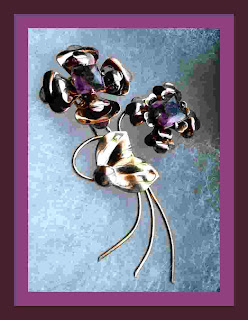
This is a gold filled brooch dating from the 1940's signed by Harry Iskin.